Circuit Operation with a published VAC (AISWEB)
Content intended for the flight simulation environment. The VAC chart images are for educational/illustrative use and may belong to third parties. In real-world operations, always use the up-to-date official publications from AISWEB or an official DECEA provider.
When a VAC exists for the aerodrome, it becomes the primary reference for:
- circuit direction per runway (left/right),
- circuit altitudes,
- reporting points and joining/leaving routes,
- local restrictions (obstacles, sensitive areas, noise),
- helicopter procedures (when published).
Operational rule
VAC / AIP / NOTAM take precedence over the "standard circuit".
What to extract from the VAC in 60 seconds (quick check)
| Item | What you are looking for | Where it normally appears |
|---|---|---|
| Runway(s) and configuration | RWY in use and alternative runways | Header / chart title |
| Circuit direction | Left or right per runway | Circuit arrows / notes |
| Circuit altitude | Minimum / standard altitude per category | Remarks / notes / annotations on the circuit |
| Joining/leaving point(s) | "ENTRY/EXIT", "GATE", "REPORTING POINTS" | VAC map and list of coordinates |
| Critical restrictions | "only right turn", areas to avoid, neighbouring traffic | Remarks |
| HEL procedure | low circuit, dedicated routes, prohibited crossings | VAC-CAT H + Remarks |
Practical example: SBCF (Confins) — VAC ACFT and VAC CAT H
Important note
The images below serve as a reading example and do not replace consulting the current publications.
VAC — ACFT (Aeroplanes)
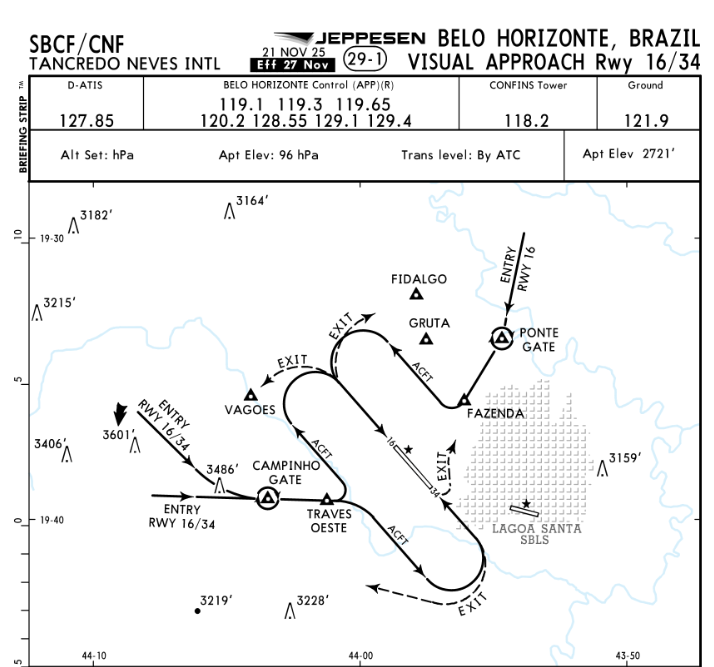
How the TWR uses it (summary of what the drawing provides):
- Shows the rectangular flow of the circuit and the ENTRY/EXIT points.
- Highlights gates/reporting points (e.g. PONTE GATE, CAMPINHO GATE, VAGOES).
- Indicates the circuit orientation per RWY (from the drawing and arrows).
- Provides context on sensitive areas (e.g. the proximity of SBLS / Lagoa Santa in the example).
VAC — CAT H (Helicopters)
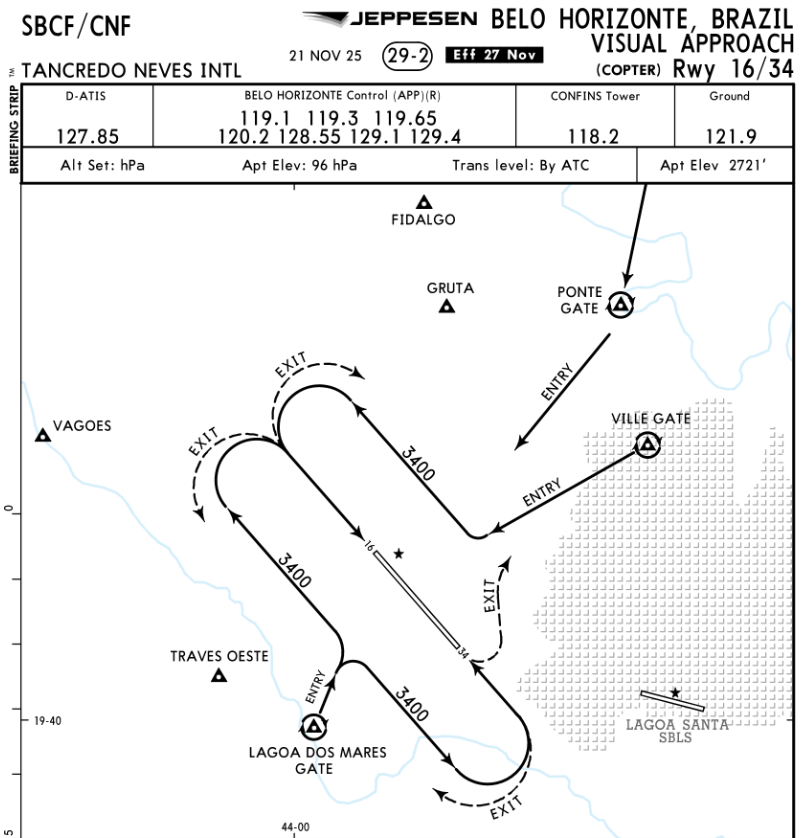
How the TWR uses it (summary of what the drawing provides):
- Defines a specific (HEL) circuit with a profile and tracks different from ACFT.
- Highlights gates and routes that avoid conflicts with fixed-wing traffic.
- Reinforces that HEL often operates with adjusted altitudes/legs (low circuit / dedicated routes).
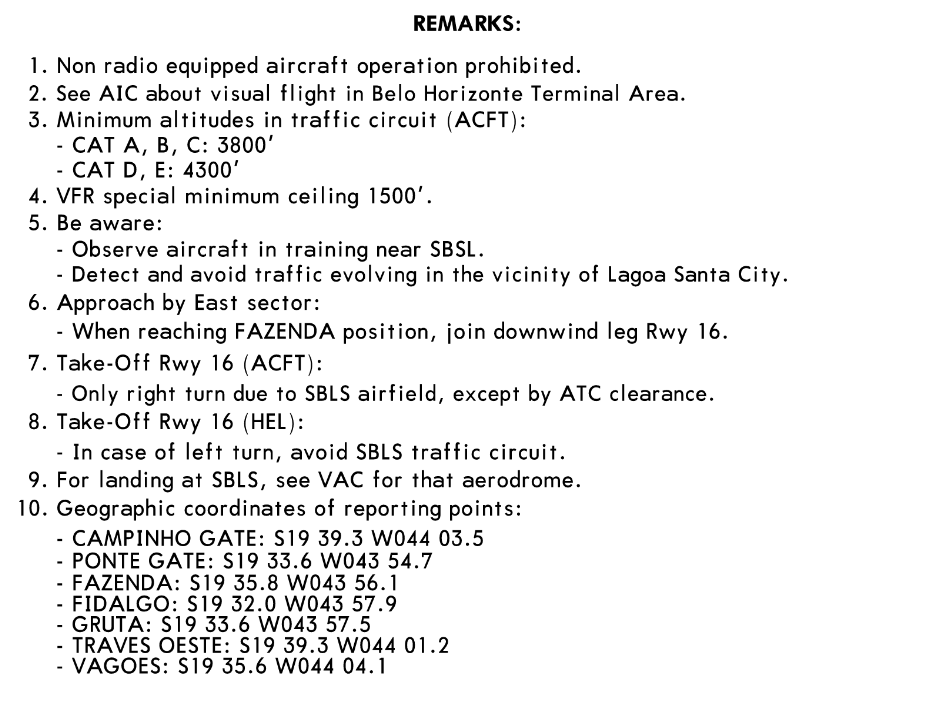
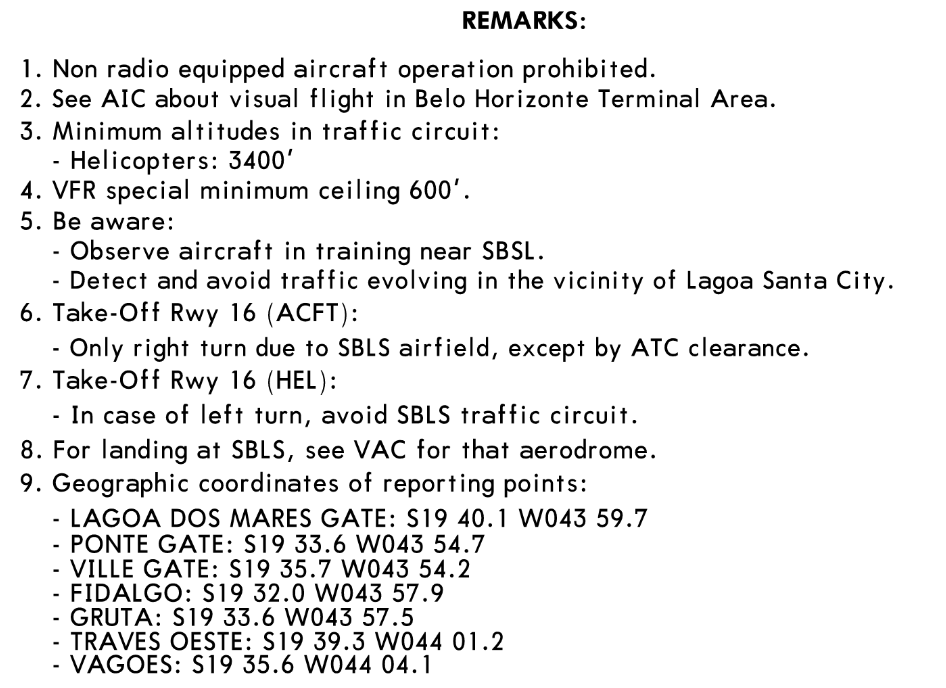
REMARKS from the example (SBCF) — what becomes an "operating rule" at the TWR
REMARKS — ACFT
REMARKS — CAT H
Operational summary (for application at the TWR)
| Topic | ACFT (according to the example remarks) | CAT H (according to the example remarks) |
|---|---|---|
| Radio | Operation of aircraft without radio prohibited | Operation of aircraft without radio prohibited |
| Area / attention | Refers to the AIC on visual flight in the TMA BH | Refers to the AIC on visual flight in the TMA BH |
| Minimum circuit altitudes | CAT A/B/C: 3800'; CAT D/E: 4300' | Helicopters: 3400' |
| Special minimum (ceiling) | 1500' | 600' |
| Nearby traffic | Watch for training traffic near SBSL and avoid traffic near Lagoa Santa | Same |
| Takeoff RWY 16 (ACFT) | Right turn only, except with ATC authorisation | (in the HEL part) if turning left, avoid the SBLS circuit |
| Approach / integration | The example states: on reaching position FAZENDA, join the RWY 16 downwind leg (eastern sector) | Apply integration according to VAC-CAT H (avoid crossing the ACFT final/flows) |
| Neighbouring aerodrome (SBLS) | For landing at SBLS, see the aerodrome's VAC | For landing at SBLS, see the aerodrome's VAC |
Practical point
With a published VAC, the TWR must treat "remarks" as mandatory restrictions and incorporate them into the briefing and the sequence.
How the TWR should apply it (summary model)
- Identify on the VAC: - runway(s) and circuit (L/R), - circuit altitude, - reporting points and gates, - restrictions and notes (remarks).
- Standardise your briefing: - "runway, circuit, altitude, reports, restrictions".
- If there is mixed traffic: - apply altitude/lateral separation without contradicting the VAC.
- If there is a conflict between safety and flow: - safety prevails (hold/orbit/extend/resequence).
Wind-based pattern: runway change and circuit mitigation
When to consider a runway change
| Signal/Hazard | Risk if you do not change | Recommended action |
|---|---|---|
| sustained wind favours another runway | increased tailwind/drift and instability | plan the transition and communicate early |
| gusts and significant variation | the sequence becomes a "puzzle" | stabilise the decision, avoid switching back and forth |
| rain/runway condition | performance/braking | use the safest runway |
| heavy traffic and frequent changes | conflict and confusion in the circuit | "freeze" the operation until it is safe to change |
How to carry out a runway change (practical procedure)
- Announce the intention in advance: - "expect runway change to ___ in X minutes".
- Stop new entries into the old circuit: - hold traffic outside / orbit / hold at a point.
- Empty the circuit: - complete pending landings/takeoffs (or go around/resequence).
- Declare the new runway and confirm the circuit according to the VAC: - direction (L/R) and altitude.
- Restart with a simple pattern: - join downwind as the default, fixed reports.
Mitigation during the transition (short rules)
- Avoid authorising a straight-in final during a runway change.
- Avoid simultaneous traffic in opposite directions (even VFR).
- Use "remain outside the circuit" to organise the queue.
- After the change, resume with one joining pattern (preferably downwind).
Standardisation block (fixed briefing ready for simulation)
TWR BRIEFING — CIRCUIT (SIM)
- Runway in use: [RWY __] (according to the VAC)
- Circuit: [LEFT/RIGHT] (according to the VAC per RWY)
- Circuit altitudes (according to the VAC/remarks):
- ACFT: [CAT A/B/C ____' | CAT D/E ____']
- HEL: [____']
- Standard joining (if the VAC indicates gates):
- "via [GATE/ENTRY] to the downwind leg", report downwind / base / final
- Restrictions (remarks):
- [right turn only after takeoff RWY __]
- [avoid area/city ___]
- [coordination with neighbouring aerodrome ___]
- Helicopters:
- operate according to VAC-CAT H, avoid crossing the ACFT final/flow without coordination
- Straight-in final:
- only if the VAC allows it and with no conflict with the circuit; otherwise, integrate via the circuit/gates
Recommendation
Use this briefing as a fixed message on the simulation server to standardise expectations and reduce repeated instructions on the radio.