Flight Plan and Capabilities
Without radar, the flight plan is the only description you have of the aircraft's intentions, and the declared capabilities determine which separation minimum can be applied.
What to check, in order
| # | Field | What it is for |
|---|---|---|
| 1 | Route | Reporting points and the adjacent unit on exit |
| 2 | Level | Compatibility with the applicable table of levels |
| 3 | Speed as a Mach number | Basis of the Mach number technique |
| 4 | Entry point and estimate | Basis of all longitudinal separation |
| 5 | Item 10a | CPDLC, PBN approval and RVSM approval |
| 6 | Item 10b | ADS-C |
| 7 | Item 18 | PBN, SELCAL, RSP and FIR estimates |
Items 1 to 4 tell you where and when. Items 5 to 7 tell you with what capability. Without both groups there is no way to choose the separation.
Speed and estimate
The cruising speed is given in item 15 with the letter M followed by three digits, for example M082 for Mach 0.821. Without a declared Mach number, the Mach number technique cannot be planned and the value will have to be requested from the pilot.
The estimate over the entry point arrives through three channels, in this order of reliability:
- Coordination from the adjacent unit.
- Item 18, indicator
EET/, for exampleEET/SBAO0234. - Your own calculation, which is an assumption and must be confirmed on first contact.
Capabilities that change separation
These three are the ones that decide the minimum. Confirm all three before planning around any conflict.
| Capability | How it appears | If absent |
|---|---|---|
| RVSM | Letter W in item 102 | Vertical separation of 2,000 ft between FL 290 and FL 4103 |
| RNP 10 | Letter R in item 10, with PBN/ in item 184 | Lateral separation of 100 NM5 |
| ADS-C | Group D1 in item 10b6 | Mandatory position reports by CPDLC or voice |
An aircraft not approved for RVSM carries STS/NONRVSM in item 18; one not certified RNP 10 carries RMK/NONRNP103 5.
Item 10: what to look for
Left-hand side, communication and navigation7:
| Code | Meaning |
|---|---|
J2 to J7 | CPDLC FANS 1/A |
J5 J6 J7 | CPDLC FANS 1/A via SATCOM |
J1 | CPDLC ATN, does not serve this FIR |
P2 | CPDLC RCP 240 |
R | PBN approved |
W | RVSM approved |
H | HF RTF |
Right-hand side, surveillance6: D1 is ADS-C FANS 1/A, which is the capability used in this FIR. G1 is ADS-C ATN.
FANS 1/A via SATCOM is the requirement
To use ADS-C and CPDLC in the Atlântico FIR the aircraft needs FANS 1/A, and the required subnetwork is SATCOM8. A J1 on its own indicates an ATN link, which does not serve.
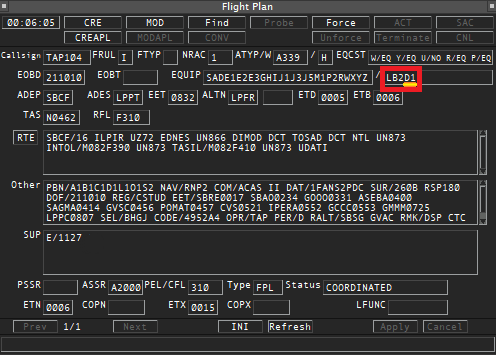
D1 group is present.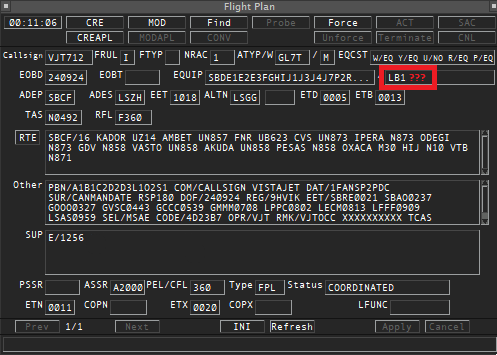
D1 group is absent.Item 18 does not replace item 10b
It is common to see SUR/RSP180 in item 18 without D1 in item 10b. The SUR/ indicator is for RSP specifications and for surveillance not specified in item 109, and it does not stand in for an ADS-C declaration. Treat the aircraft as having no ADS-C until the pilot confirms otherwise.
Item 18: useful indicators
| Indicator | Content | Example |
|---|---|---|
PBN/ | Navigation specifications4 | PBN/A1B1C1D1 |
SUR/ | RSP specifications9 | SUR/RSP180 |
SEL/ | SELCAL code10 | SEL/FKLM |
EET/ | Accumulated estimates to the FIR | EET/SBAO0234 |
DAT/ | Data link capabilities | DAT/1FANS2PDC |
Without SEL/, no selective calling is possible: the only way to recover a silent aircraft becomes a voice call.
Declared is not available
The most important distinction on this page
Nothing on VATSIM verifies certification. A D1 in the flight plan does not guarantee a data link logon, and the pilot may not even know how to operate the feature.
Confirm on first contact. Until the capability shows itself in practice, apply the separation corresponding to the capability you observe, not the one that was declared.
If the aircraft reports a navigation, communication or surveillance degradation at any time, the minimum that depended on that capability no longer applies: reassess the affected pairs and establish another form of separation before the previous one is infringed11. The procedure is in Coordination and contingencies.