SBMO - Maceió
General Information
| Information | |
|---|---|
| Aerodrome name | Maceió - Zumbi dos Palmares |
| Type of Operation | International and Public |
| Transition altitude | 10000 ft6 |
| Elevation | 388 ft (118 m) |
| Largest aircraft | Code 4E (A330, B767, B787)2 |
| Airspace | Maceió CTR, class D, GND/3500 ft6 |
| Accepts A380? |
Useful Information
Select one of the tools in the tabs above (Charts, Weather or Traffic) to access the aerodrome information.
Runways
Runway system
SBMO has one runway, 12/30 (2602 × 45 m, asphalt). E runs along the south side of the runway from end to end, from A (threshold 12) to D (threshold 30). The aprons are to the south: apron 2 (TPS 2) to the west, next to threshold 12, and apron 1 (TPS 1) in the middle of the field.
-
Runway
12
ILS CAT I. Takeoff from the threshold, via A.
-
Runway
30
RNP and VOR. Threshold displaced 112 m. Takeoff from the start of the runway, via D.
Runway selection
The AIP sets no preferential runway: the runway in use follows the wind.
Runway data
| Runway | Dimensions | TORA | LDA | Approach | Remarks |
|---|---|---|---|---|---|
| 12 | 2602 × 45 m | 2490 m | 2490 m | ILS CAT I | The last 112 m (before THR 30) are not part of the TORA1 |
| 30 | 2602 × 45 m | 2602 m | 2490 m | Non-precision | RNP and VOR. Threshold displaced 112 m1 |
- The AD accepts aircraft up to code 4E2.
- 180° turns for aircraft the size of a FOKKER 100, B737 or larger only at the thresholds3.
ATC Units
| Code | Abbr. | Callsign | Frequency | Remarks |
|---|---|---|---|---|
| SBMO_TWR | TMO | Maceió Tower | 118.250 | DCL (code SBMO) |
- The VATSIM package only has Tower: there is no Ground, Clearance Delivery or voice ATIS. The AIP lists TWR 118.000 and 118.250 and D-ATIS only4.
- Above Tower, top-down: SBXM_APP (Maceió Control, 119.250), which controls the Maceió CTR and TMA.
DCL
SBMO has DCL (departure clearance via datalink)4. On the network, the station code is SBMO. There is no Clearance Delivery (DEL) position: Tower issues the clearances.
| Station code | SBMO |
| Who operates it | SBMO_TWR. Without TWR, the position covering clearance top-down (APP or ACC) |
| Controller tool | TopSky DCL window, with your personal Hoppie ACARS code |
| Pilot tool | Aircraft ACARS or a Hoppie-compatible client, sending the clearance request to SBMO |
How it works:
- The pilot sends the request (RCD) to
SBMO, with the parking stand and the ATIS letter, if any. - The controller checks the flight plan and replies with the clearance: limit, runway, SID, transponder code and next frequency.
- The pilot accepts (
WILCO/ACCEPT). The clearance is then issued and there is no voice readback. - With the clearance accepted, the pilot calls Tower for start-up or pushback.
Controller setup
- Log in to the TopSky DCL with the code
SBMObefore opening the position. - Announce it in the controller information:
DCL AVBL LOGON SBMO. - A faulty request (invalid plan, wrong SID) goes back as REVERT TO VOICE: the pilot calls Tower on frequency.
- If the pilot does not accept within a reasonable time, consider the clearance not delivered and call them by voice.
Areas of responsibility
Since there is only a Tower position, SBMO_TWR controls everything: aprons, taxiways and runway 12/30. Neither the AIP nor the package has a Ground or Apron position.
- Departure: Tower issues the clearance (DCL or voice), approves pushback and taxi, and clears the takeoff on the same frequency.
- Arrival: Tower clears the landing and, once the aircraft has vacated, the taxi to the apron.
- Pushback is mandatory for aircraft above 40 t leaving the stand5.
Ground flow
General rule
- E runs south of the runway, from A (threshold 12) to D (threshold 30).
- G (west) and F (east) link E to apron 1; apron 2 faces E, between A and B.
- B and C are rapid exits: B for runway 30 landings and C for runway 12 landings.
- K leads to the engine run-up area, north of the runway.
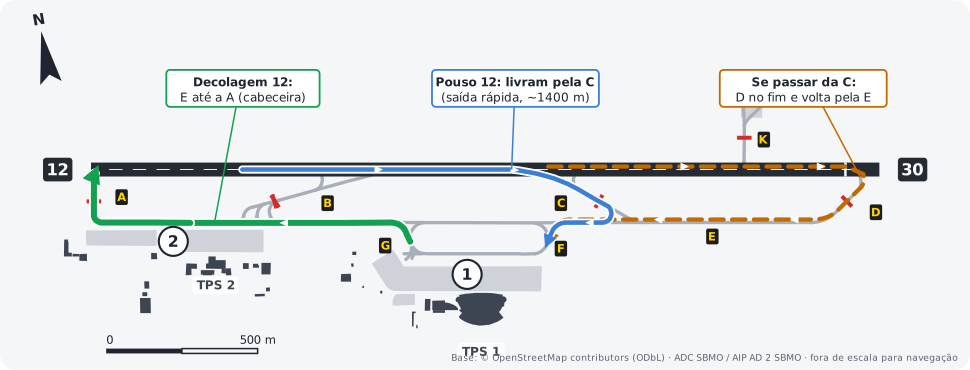
- Departures (12): E west to A (threshold 12). From apron 1, leave via G.
- Landings (12): vacate via C (rapid exit, ~1390 m) and continue via E and F to apron 1. Aircraft rolling past C go to the end, vacate via D and return via E.
Example: AZU4321, taxi to holding point runway 12 via G, E and A.
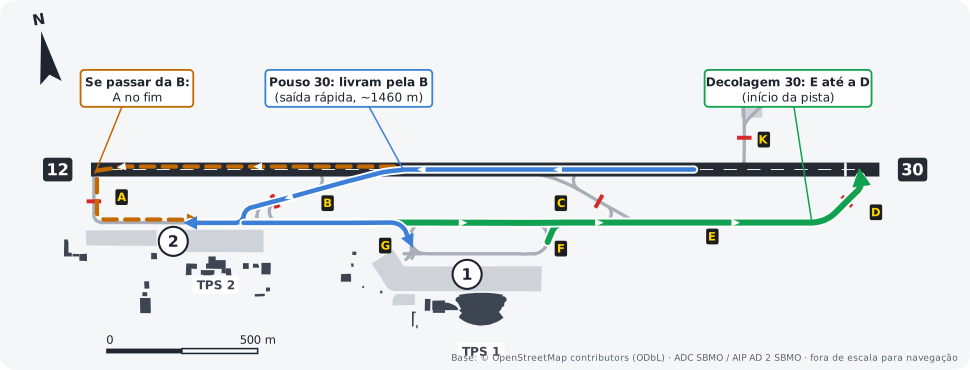
- Departures (30): E east to D. The takeoff starts at the beginning of the runway, before the displaced threshold (TORA 2602 m). From apron 1, leave via F.
- Landings (30): vacate via B (rapid exit, ~1460 m) to apron 2, or continue via E and G to apron 1. Aircraft rolling past B go to the end and vacate via A.
Example: GLO1234, taxi to holding point runway 30 via F, E and D.
Runway exits
| Runway | Exits |
|---|---|
| 12 | C (~1390 m, rapid exit) or D (end) |
| 30 | C (~850 m, light aircraft), B (~1460 m, rapid exit) or A (end) |
Approximate distance from the threshold to the exit, measured on the diagram. The SBMO AIP does not publish exits.
Takeoff points
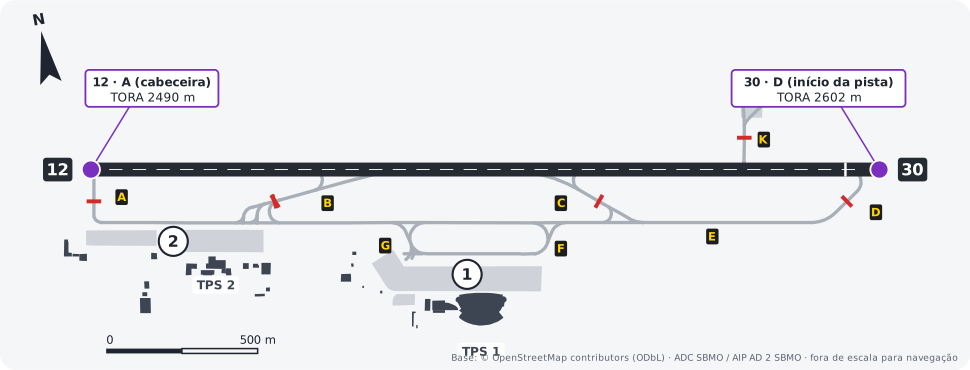
| Runway | Point | TORA | Used by |
|---|---|---|---|
| 12 | A (threshold) | 2490 m | All |
| 30 | D (start of runway) | 2602 m | All |
- The SBMO AIP does not publish intersection takeoffs.
Aprons and airlines
Reference for simulation. Stands follow the PDC charts; airlines follow the airport's airline list on Wikipedia. The split between stands is a simplification, not the airport's official allocation. VAs use the stands of the real airline they represent.



General and business aviation.
Logos from GRU Airport. Trademarks belong to their respective airlines.
Other procedures
- Observe the VAC for joining and leaving the traffic pattern7.
- On a visual approach, do not confuse the field with runway 14/32 of the Alagoas Aero Club, 7 NM to the southeast7.
- Not allowed at SBMO: aircraft without radio, without a transponder (or with it failed), gliders and powered ultralights. Parachute drops, aircraft towing and aerobatic flights are also prohibited2.
Diagrams drawn by VATSIM Brasil over OpenStreetMap geometry (ODbL), checked against the SBMO ADC and PDC charts. Not for real-world navigation. Normative source: AIP Brasil, AD 2 SBMO, AMDT 2610A1.