SBGR - Guarulhos
General Information
| Information | |
|---|---|
| Aerodrome name | Governador André Franco Montoro |
| Type of Operation | International, Public and Military |
| Transition altitude | 8000 ft |
| Elevation | 2461 ft (750 m) |
| Reference code | 4E19 |
| Airspace | Guarulhos CTR, class D, GND/3600 ft17 |
| Operation | IFR. Fixed-wing VFR prohibited, except Brazilian military18 |
| Accepts A380? | 19 |
Useful Information
Select one of the tools in the tabs above (Charts, Weather or Traffic) to access the aerodrome information.
Runways
Preferred runways
The two runways are parallel and only 375 m apart, centreline to centreline. That is why there are no independent operations: normally one runway is for landing and the other for takeoff1.
-
Landings:
10R/28L
South runway, 3000 × 45 m. Preferred for landing. ILS CAT III on 10R and CAT I on 28L.
-
Takeoffs:
10L/28R
North runway, 3700 × 45 m, next to the aprons. Preferred for takeoff. ILS CAT II on 10L and CAT I on 28R.
Preferred system: runways 10
With a tailwind component of less than 7 kt and a dry runway, the preferred system is 10R/10L, used in preference to 28L/28R1.
With system 10 in use and a tailwind, pilots who request system 28 must expect a delay in landing or takeoff1.
| Configuration | Landing | Takeoff | When |
|---|---|---|---|
| 10 (preferred) | 10R | 10L | Tailwind < 7 kt and dry runway |
| 28 | 28L | 28R | Other cases (tailwind ≥ 7 kt on 10 or runway not dry), according to the wind |
Runway data
| Runway | Dimensions | TORA | LDA | Approach | Remarks |
|---|---|---|---|---|---|
| 10L | 3700 × 45 m | 3700 m | 3610 m | ILS CAT II, RNP | Threshold displaced 90 m |
| 28R | 3700 × 45 m | 3700 m | 3640 m | ILS CAT I, RNP | Threshold displaced 60 m |
| 10R | 3000 × 45 m | 3000 m | 3000 m | ILS CAT III, RNP | TODA 3300 m (300 m clearway) |
| 28L | 3000 × 45 m | 3000 m | 3000 m | ILS CAT I, RNP |
ATC Units
| Code | Abbr. | Callsign | Frequency | Remarks |
|---|---|---|---|---|
| SBGR_ATIS | AGR | ATIS | 127.750 | D-ATIS |
| SBGR_DEL | DGR | Guarulhos Clearance | 121.000 | DCL (code SBGR) |
| SBGR_GND | GGR | Guarulhos Ground | 121.700 | |
| SBGR_TWR | TGR | Guarulhos Tower | 132.750 |
DCL
SBGR has DCL (departure clearance via datalink). On the network, the station code is SBGR.
| Station code | SBGR |
| Who operates it | SBGR_DEL. Without DEL, whichever position covers clearance top-down (GND, TWR, APP or ACC) |
| Controller tool | TopSky DCL window, with your personal Hoppie ACARS code |
| Pilot tool | Aircraft ACARS or a Hoppie-compatible client, sending the clearance request to SBGR |
| Timing | Request no earlier than 15 minutes before EOBT2 |
How it works:
- The pilot sends the request (RCD) to
SBGR, with the stand and the ATIS letter. - The controller checks the flight plan and replies with the clearance: limit, runway, SID, squawk, ATIS letter and next frequency.
- The pilot accepts (
WILCO/ACCEPT). The clearance is then delivered and no voice readback is needed. - Once the clearance is accepted, the pilot calls Ground directly for start-up or pushback.
Controller setup
- Log in to the TopSky DCL with the code
SBGRbefore opening the position. - Announce it in the controller information:
DCL AVBL LOGON SBGR. - A request with errors (invalid plan, wrong SID, no ATIS) is answered with REVERT TO VOICE: the pilot calls Clearance on frequency.
- If the pilot does not accept within a reasonable time, treat the clearance as not delivered and call by voice.
Intersection takeoff in the clearance request
Pilots must say when requesting clearance if they cannot take off from the published intersections (see Takeoff points). In a DCL, this goes in the free-text field of the request3.
Areas of responsibility
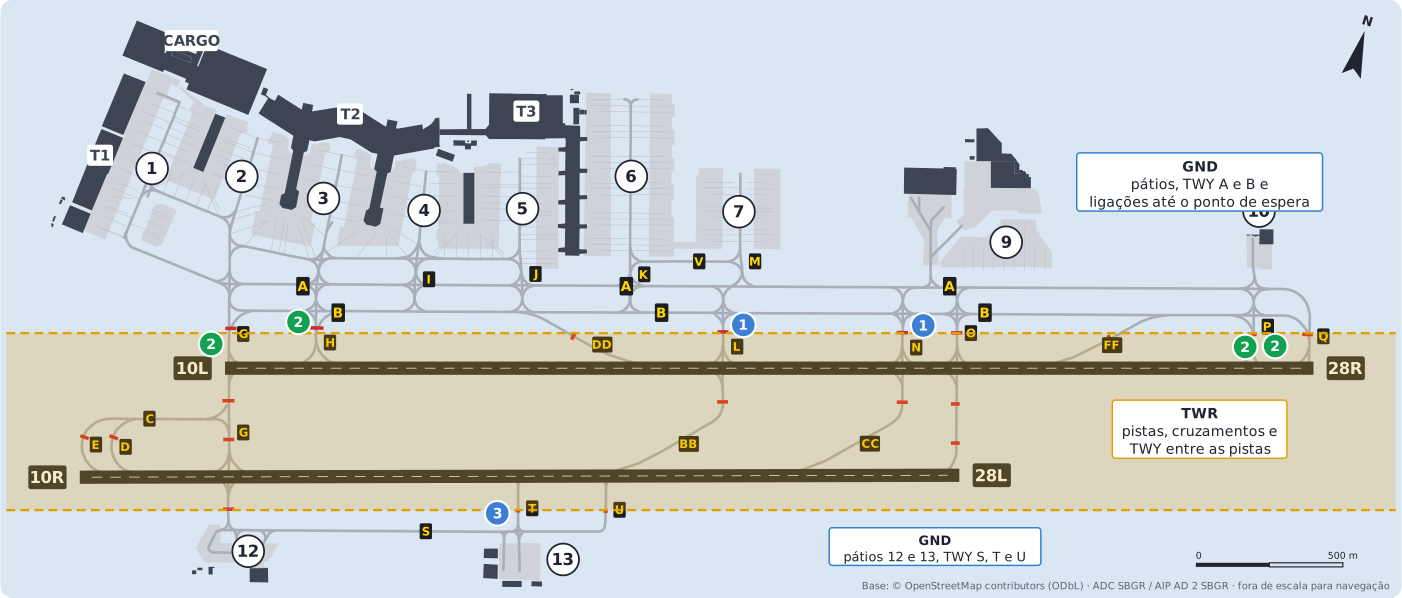
The split follows the runway holding points. Everything between the holding points north of 10L/28R and south of 10R/28L belongs to Tower.
| Position | Responsible for |
|---|---|
| GND | Aprons 1 to 10, TWY A and B, Y taxilanes, TWY V and M and the links (G, H, I, J, K, L, N, O, P, Q) up to the 10L/28R holding point. South side: aprons 12 and 13 and TWY S, T and U up to the 10R/28L holding point |
| TWR | Both runways, all crossings, the rapid exits BB, CC, DD, FF and the taxiways between the runways (C, D, E and the parts of G, BB, CC and O between 10L and 10R) |
Handoff points (colored circles on the map):
- Arrival on 10R/28L bound for the north aprons: the aircraft stays on Tower frequency, holds and crosses 10L/28R with Tower clearance and only calls Ground after crossing and vacating 10L/28R4.
- Departure: Ground hands the aircraft to Tower before the holding point of the departure runway. To ease frequency load, Ground may instruct the pilot to monitor Tower, without an initial call5.
- Arrival bound for aprons 12 and 13: the aircraft vacates 10R/28L to the south (T or U) and calls Ground after vacating.
Crossing the adjacent runway
- An aircraft vacating a runway must NEVER cross the parallel runway without specific ATC clearance.
- An aircraft holding to cross stays on Tower frequency and does not request the crossing: Tower will call.
- Once cleared, cross promptly.4.
Ground flow
General rule
- TWY A is the standard route, in both directions, between the aprons and the runway ends.
- TWY B is the alternative: use it when A is busy or closed, to pass a stopped aircraft or to keep opposite flows apart.
- The links between A, B and the runway (G, H, L, N, O, P, Q) are used to enter and vacate. Rapid exits BB, CC, DD and FF are for vacating only.
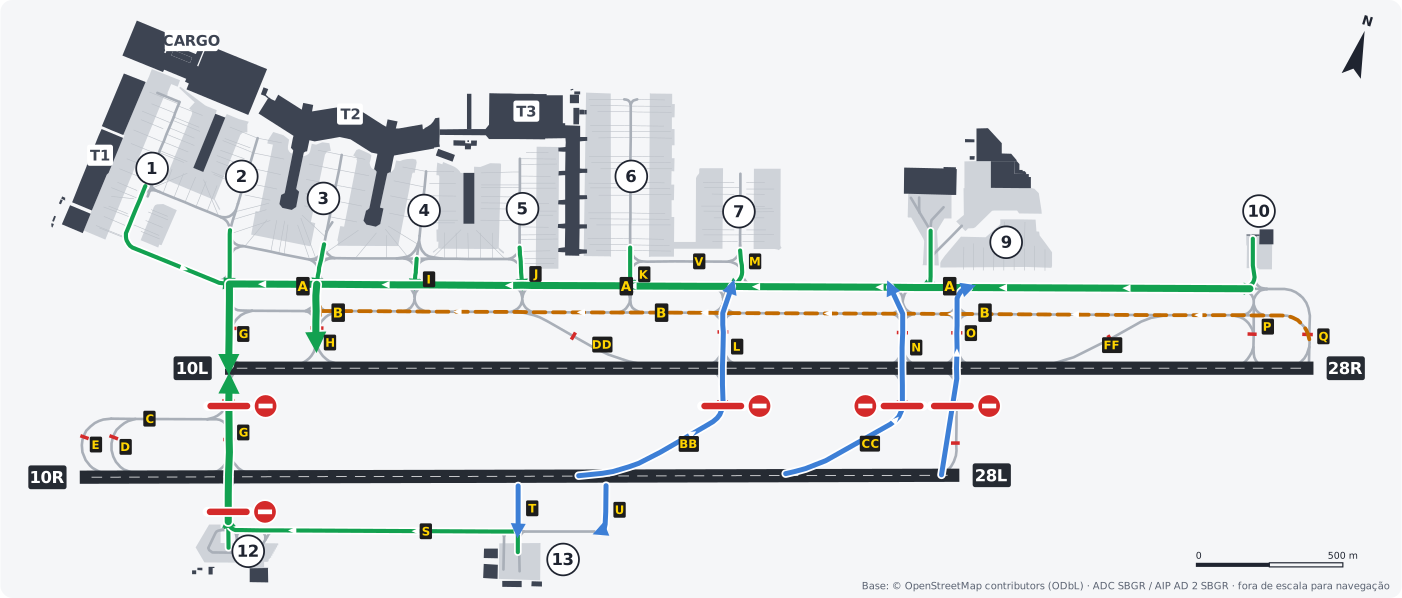
- Departures (10L): taxi via A westbound to G (full length) or H (intersection).
- Arrivals (10R): CAT C, D and E vacate via BB, CC or O (end of the runway), hold short of 10L and cross via L, N or O onto A. CAT A and B vacate via T or U, to the south.
- Aprons 12 and 13: via S to G, crossing 10R with Tower clearance, to the 10L holding point on G.
- Alternative: B westbound to H or G.
Example: TAM3456, taxi to holding point runway 10L via A, G.
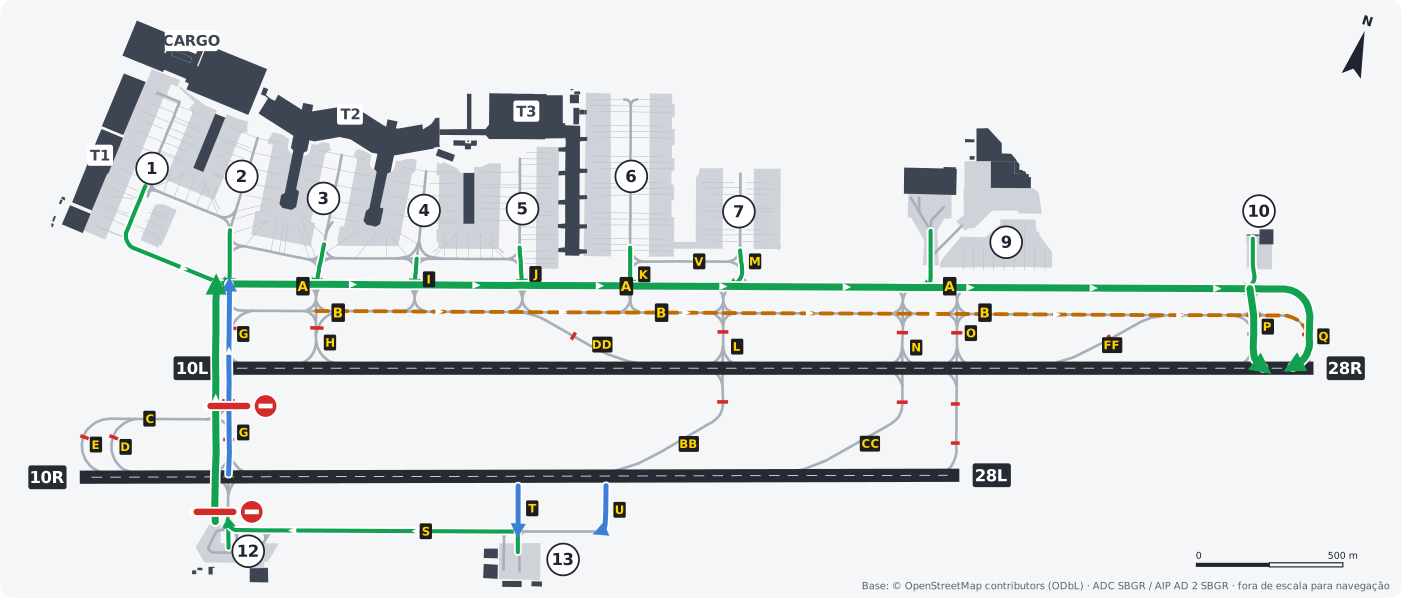
- Departures (28R): taxi via A eastbound to Q (full length), P or O (intersections).
- Arrivals (28L): CAT C, D and E vacate via G, hold short of 10L and cross via G onto A. CAT A and B vacate via T or U, to the south.
- Aprons 12 and 13: via S to G, crossing 10R and 10L with Tower clearance, then via A.
- Alternative: B eastbound to P or Q.
Example: GLO1234, taxi to holding point runway 28R via A, Q.
Runway exits
To ensure minimum runway occupancy time (MROT), pilots must vacate via the taxiways below or tell Tower on first contact if they cannot6.
| Runway | CAT A and B | CAT C and D | CAT E |
|---|---|---|---|
| 10R | T (1497 m) or U (1795 m) | BB or CC (2450 m) or O (3000 m, end of the runway) | BB, CC or O |
| 10L | L (1061 m) | N (2212 m) or O (2397 m) | N, O or FF (2840 m) |
| 28R | O (1155 m) or N (1340 m) | L (1951 m) or DD (2340 m) | L or DD |
| 28L | T (1502 m) or U (1204 m) | G (2487 m) | G |
Distance from the threshold to the exit taxiway.
Taxi restrictions
By aircraft size7:
| Aircraft | Where it cannot taxi |
|---|---|
| Wingspan above 44 m | TWY S, T and U |
| Code F (e.g. A380, B747-8) | TWY A between G and apron 1 |
| TWY M and V | |
| TWY G between 10R/28L and apron 12 | |
| The taxilanes inside aprons 1 to 5 (see below) |
On TWY V, and on TWY A between G and apron 1, the maximum wingspan is 65 m.
What the apron 1 to 5 taxilanes are
They are the taxi lines painted inside the aprons, in red and blue, that lead to the parking stands. The AIP gives them their own names: Y1W, Y1E, Y2W, Y2E, and so on up to Y5W and Y5E. The number is the apron; W and E mean the west or east side.
Other restrictions:
- Low visibility (RVR < 400 m): progressive taxi on the standard taxi routes, with short instructions from Ground8.
Takeoff points
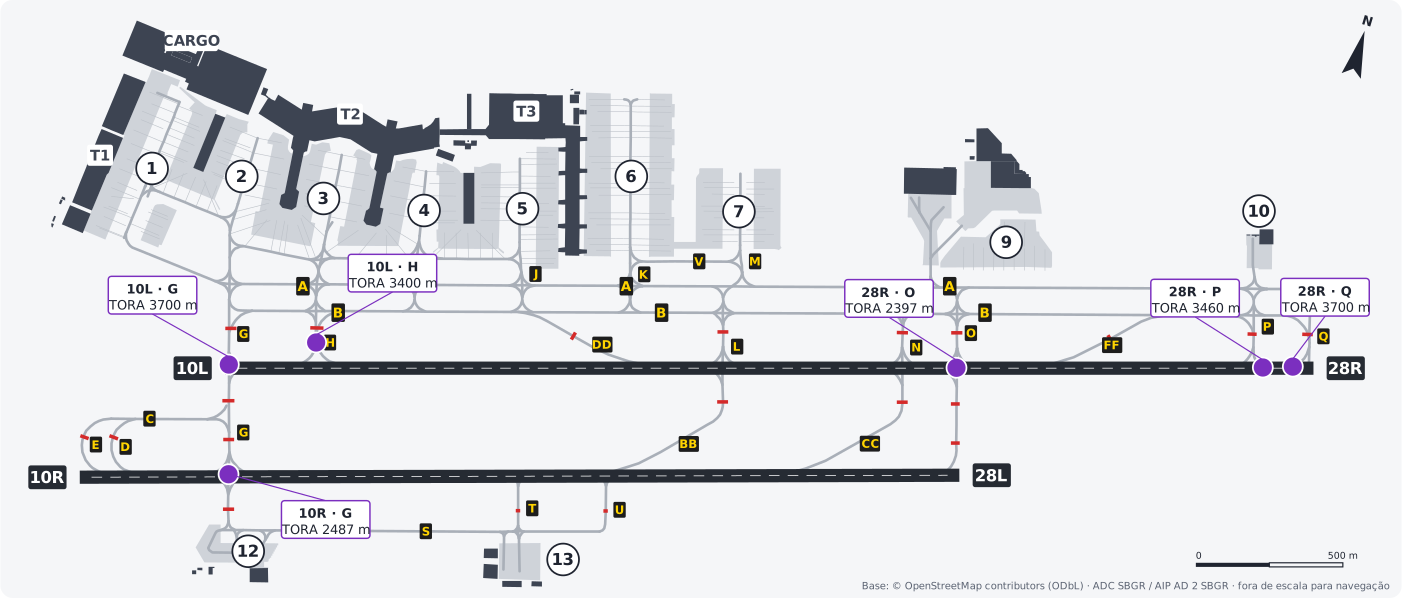
Aircraft of category D or smaller must be ready to take off from the intersections below9. In practice, Tower uses the intersection to fit departures between arrivals.
| Runway | Point | TORA | Used by |
|---|---|---|---|
| 10L | G (full length) | 3700 m | Aprons 1 and 2, CAT E and anyone unable to accept the intersection |
| 10L | H | 3400 m | Aircraft from aprons 3, 4, 5, 6 and 7 |
| 28R | Q (full length) | 3700 m | CAT E and anyone unable to accept the intersection |
| 28R | P | 3460 m | CAT D or smaller |
| 28R | O | 2397 m | CAT D or smaller |
| 10R | G | 2487 m | Dependent parallel departures (see below) |
- Pilots say when requesting clearance if they cannot take off from the intersection3.
- Pilots reach the holding point ready for departure; if not, they tell Ground.
- Line up immediately when cleared, and start the takeoff roll within 10 seconds of the takeoff clearance.
- Tower does not give landing and takeoff times10.
Segregated operations
In segregated operations, 10R/28L takes the landings and 10L/28R the takeoffs at the same time. Because the runways are only 375 m apart, a go-around from one and a takeoff from the other may conflict. That is why separation between them is visual, kept by the pilot of the aircraft going around11.
Conditions11:
| Condition | Value |
|---|---|
| Weather | VMC, ceiling ≥ 1000 ft and visibility ≥ 5000 m |
| Divergence | Departure and missed approach paths diverge by at least 15° |
| Wake on final | The aircraft on final approach must not be HEAVY |
| Wake on runway 28 departures | The aircraft taking off from RWY 28 must not be HEAVY |
| Publication | Operation in progress and IAC in use announced on the ATIS (or on VHF, without ATIS) |
Outside these conditions there are no segregated operations: Tower separates landings and takeoffs on the two runways without relying on visual separation.
The pilot-in-command must11:
- Tell Tower if visual references are lost on final. Without a report, ATC assumes the pilot has visual references below 1000 ft and will apply visual separation in case of a go-around.
- In a go-around, maintain visual separation from the aircraft taking off from the adjacent runway.
- Keep the other aircraft in sight until it is no longer essential traffic.
- Observe wake turbulence separation when told to maintain visual separation, and ask for extra spacing if needed.
- Add HEAVY or SUPER right after the callsign on initial contact, when applicable.
Go-around phraseology11:
Dependent parallel departures
When there are more departures than arrivals, Tower may launch from both runways (10R/10L or 28L/28R)12:
- Minima: visibility ≥ 5000 m and ceiling ≥ 1000 ft.
- Departure paths diverge by at least 15° up to 2 NM from the end of the runway.
- Operation announced on the ATIS.
- Pilots say at clearance if they cannot operate on 10R/28L and, for code C or D, when requesting taxi if they cannot take off from H (10L), G (10R) or P (28R). On first contact with São Paulo Control they state the departure runway.
RRSM
RRSM (Reduced Runway Separation Minima) is the reduced minimum separation between aircraft on the same runway. With RRSM, Tower may clear a landing or takeoff before the preceding aircraft has vacated the runway, provided there is reasonable assurance that the distance below will exist. SBGR was the first aerodrome in Brazil to use it13.
Conditions (all of them)13:
- From sunrise to sunset.
- Visibility ≥ 5 km and ceiling ≥ 1000 ft.
- Tailwind up to 3 kt.
- Dry runway: no rain, snow or ice reported in the METAR.
- Wake turbulence minima applied as usual.
- RRSM announced on the ATIS.
Minimum distance: 2400 m from the threshold, which corresponds to:
| Runway in use | Landing after landing | Landing after takeoff / takeoff after takeoff |
|---|---|---|
| 10R | Preceding aircraft past CC, moving and vacating without backtracking | Preceding aircraft past CC |
| 28L | Preceding aircraft past G, moving and vacating without backtracking | Preceding aircraft past G |
| 10L | Preceding aircraft past O, moving and vacating without backtracking | Preceding aircraft past O |
| 28R | Preceding aircraft past DD, moving and vacating without backtracking | Preceding aircraft past DD |
Tower gives traffic information with the clearance:
Aprons and airlines
A reference for simulation. Terminals follow the GRU Airport airline directory; the split between aprons is a simplification, not the airport's official allocation. VAs use the aprons of the real airline they represent.




































Any airline, subject to availability.
and overflow from the other aprons.
General aviation and air taxi.
- General aviation parks only on apron 1214.
- Military aircraft bound for BASP (apron 13) stay with Ground, like any other traffic.
Logos from GRU Airport, Travelpayouts (Cargolux and Atlas Air), Wikipedia (Sideral) and Voe Samba. Trademarks belong to their respective airlines.

Other procedures
Approaches and landings
- HIRO (high-intensity runway operations) H24: pilots adjust landing and takeoff for minimum runway occupancy15.
- Approach speeds: 180 kt at 10 NM and 160 kt at 5 NM from the threshold. ATC-assigned speeds are mandatory; pilots unable to comply must say so16.
- Minimum surveillance separation on final: 3 NM13.
- Vacate the runway completely before stopping.
- Pilots do not report gear down, except in an emergency.
Communications
- To avoid frequency congestion, ATC may instruct pilots to monitor the next frequency. In that case there is no initial call5.
Aerodrome regulations
- Fixed-wing VFR prohibited, except Brazilian military or non-RNAV aircraft when conventional procedures are unavailable18.
- Training flights (circuits, touch-and-go) at Tower's discretion, depending on traffic.
Diagrams drawn by VATSIM Brasil on OpenStreetMap geometry (ODbL), checked against the SBGR ADC chart (AIRAC 2605). Not for real-world navigation. Normative source: AIP Brasil, AD 2 SBGR, AMDT 2610A1.
-
AIP Brasil, AD 2 SBGR 2.20, item 1.1. Declared distances: AD 2.13 and ADC chart. ↩↩↩
-
AIP Brasil, AD 2 SBGR 2.20, item 12 and AD 2.8. ↩
-
AIP Brasil, AD 2 SBGR 2.20, item 4.2. See also the DECEA news item (Portuguese). ↩↩↩
-
AIP Brasil, AD 2 SBGR 2.20, item 8 and AD 2.8. ↩