SBGL - Galeão
General Information
| Information | |
|---|---|
| Aerodrome name | Galeão - Antônio Carlos Jobim |
| Type of Operation | International, Public and Military |
| Transition altitude | 7000 ft |
| Elevation | 28 ft (9 m) |
| Largest aircraft | Wide-bodies (code 4E); A380 and B747-8 under special procedures1 |
| Airspace | Galeão CTR, class D, GND/2000 ft9 |
| Accepts A380? | 1 |
Useful Information
Select one of the tools in the tabs above (Charts, Weather or Traffic) to access the aerodrome information.
Runways
Preferential runway system
SBGL has two runways that do not cross but converge to the west: 10/28 (4000 m, concrete), north of the terminals, and 15/33 (3180 m, asphalt), southwest of them3.
-
Takeoffs:
10
4000 × 45 m. Preferential for takeoff in segregated operations. ILS CAT II on 10 and ILS on 28.
-
Landings:
15
3180 × 47 m. Preferential for landing in segregated operations. ILS on 15. Displaced thresholds in both directions.
Preferential system
With a tailwind component of 7 kt or less and dry runways, the configuration in the table below applies, according to the scenario in use3.
With the preferential system in use, pilots requesting the alternate system should expect a delay to their landing or takeoff3.
| Scenario | Landings | Takeoffs | When |
|---|---|---|---|
| Segregated operations (preferential) | 15 | 10 | Tailwind of 7 kt or less and dry runways |
| Single runway 15/33 | 15 | 15 | Only 15/33 available |
| Single runway 10/28 | 10 | 10 | Only 10/28 available |
| Converging operations | 28 | 33 | Activated by Tower, see Converging operations |
Runway data
| Runway | Dimensions | TORA | LDA | Approach | Remarks |
|---|---|---|---|---|---|
| 10 | 4000 × 45 m | 4000 m | 4000 m | ILS CAT II | |
| 28 | 4000 × 45 m | 4000 m | 4000 m | ILS | |
| 15 | 3180 × 47 m | 3060 m | 2930 m | ILS | Displaced threshold (130 m) |
| 33 | 3180 × 47 m | 3050 m | 2930 m | Non-precision | Displaced threshold (120 m) |
- On 15/33, pilots start the takeoff from the beginning of the runway, without taxiing to the displaced threshold2.
- The aerodrome accepts aircraft up to code 4E. The A380 and B747-8 operate under special procedures1.
ATC Units
| Code | Abbr. | Callsign | Frequency | Remarks |
|---|---|---|---|---|
| SBGL_ATIS | AGL | Galeão ATIS | 127.600 | D-ATIS |
| SBGL_DEL | DGL | Galeão Clearance | 121.000 | DCL (code SBGL) |
| SBGL_RMP | RGL | Galeão Apron | 121.950 | Events only |
| SBGL_GND | GGL | Galeão Ground | 121.650 | |
| SBGL_TWR | TGL | Galeão Tower | 118.000 |
DCL
SBGL has DCL (departure clearance via datalink)4. On the network, the station code is SBGL.
| Station code | SBGL |
| Who operates it | SBGL_DEL. Without DEL, whichever position covers clearance top-down (GND, TWR, APP or ACC) |
| Controller tool | TopSky DCL window, with your personal Hoppie ACARS code |
| Pilot tool | Aircraft ACARS or a Hoppie-compatible client, sending the clearance request to SBGL |
How it works:
- The pilot sends the request (RCD) to
SBGL, with the stand and the ATIS letter. - The controller checks the flight plan and replies with the clearance: limit, runway, SID, squawk, ATIS letter and next frequency.
- The pilot accepts (
WILCO/ACCEPT). The clearance is then delivered and no voice readback is needed. - Once the clearance is accepted, the pilot calls Apron (or Ground, without Apron) for start-up or pushback.
Controller setup
- Log in to the TopSky DCL with the code
SBGLbefore opening the position. - Announce it in the controller information:
DCL AVBL LOGON SBGL. - A request with errors (invalid plan, wrong SID, no ATIS) is answered with REVERT TO VOICE: the pilot calls Clearance on frequency.
- If the pilot does not accept within a reasonable time, treat the clearance as not delivered and call by voice.
Areas of responsibility
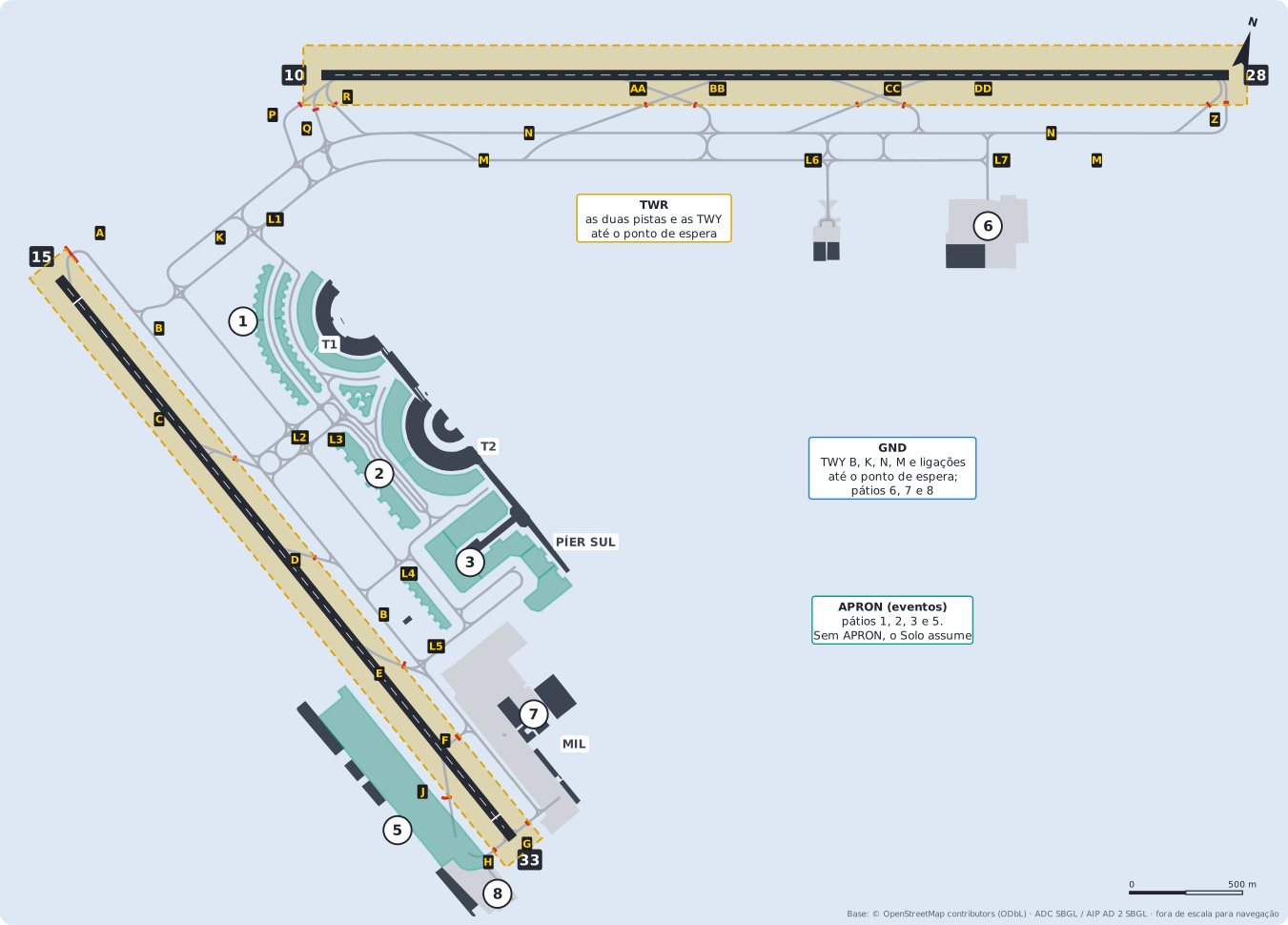
| Position | Responsible for |
|---|---|
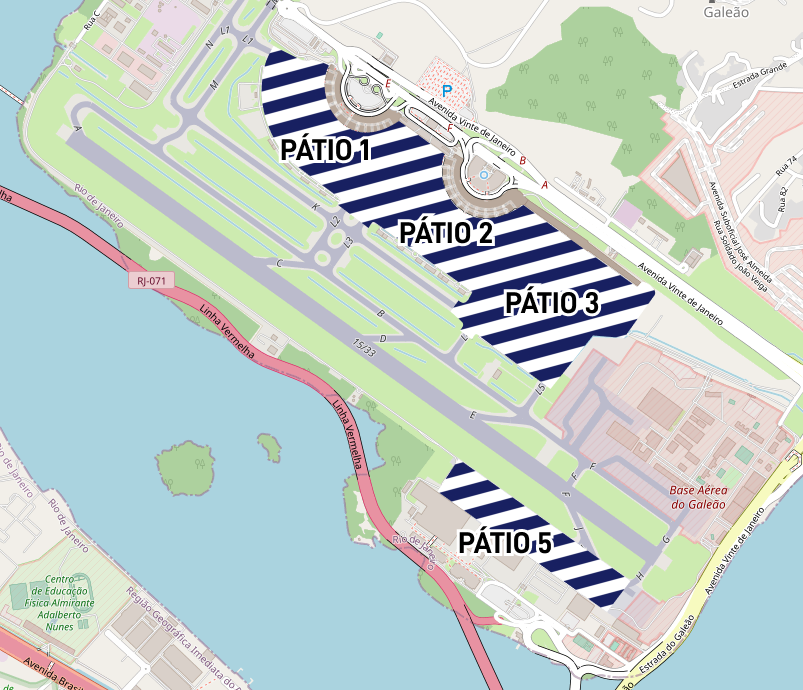
| APRON (events only) | Aprons 1, 2, 3 and 5, up to the apron exit |
| GND | TWY B, K, N, M and the links up to the holding point; aprons 6, 7 and 8. Without APRON, also aprons 1, 2, 3 and 5 |
| TWR | Both runways, the 15/33 crossings and the taxiways inside the holding points |
- With Apron online, aircraft bound for aprons 1, 2, 3 and 5 call Apron before entering the apron4.
- Departure: Apron hands the aircraft to Ground at the apron exit; Ground hands it to Tower before the holding point.
- Arrival: after vacating, Tower hands the aircraft to Ground; Ground hands it to Apron before the apron entry.
Galeão Apron area of responsibility
Ground flow
General rule
- TWY B runs along 15/33 and links aprons 2, 3 and 5 to the runway 15 and 33 ends. K and Y run between B and the terminals.
- N and M run along 10/28. L1 links apron 1 to N, which leads to the runway 10 threshold via P.
- L2 to L5 link the aprons to B.
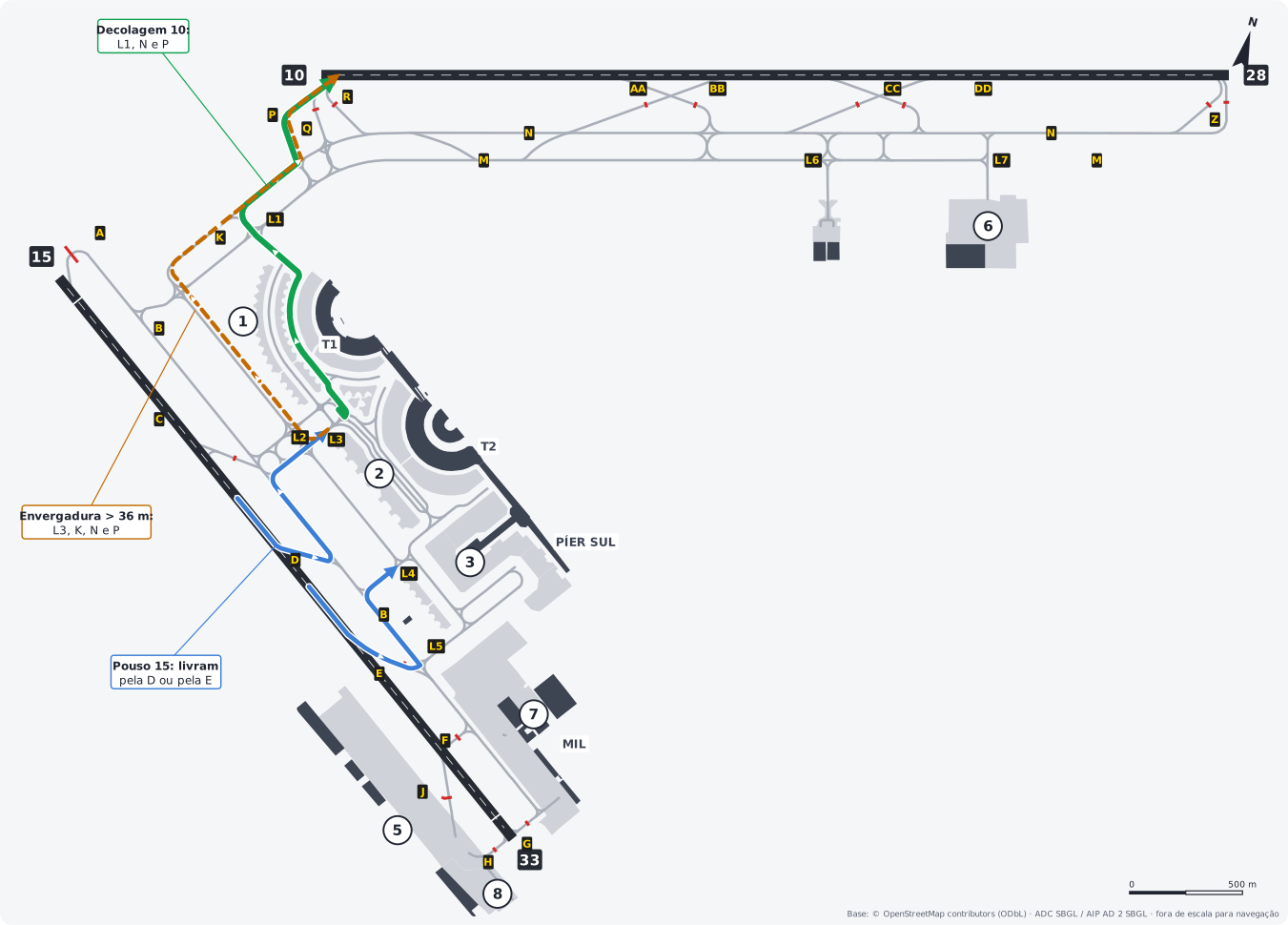
- Departures (10): L1, N and P to the runway 10 threshold.
- Wingspan above 36 m (10): leave apron 2 via L3, then K, N and P.
- Landings (15): vacate via D or E and continue on B to the apron link (L2 to L5).
Example: GLO1234, taxi to holding point runway 10 via L1, N, P.
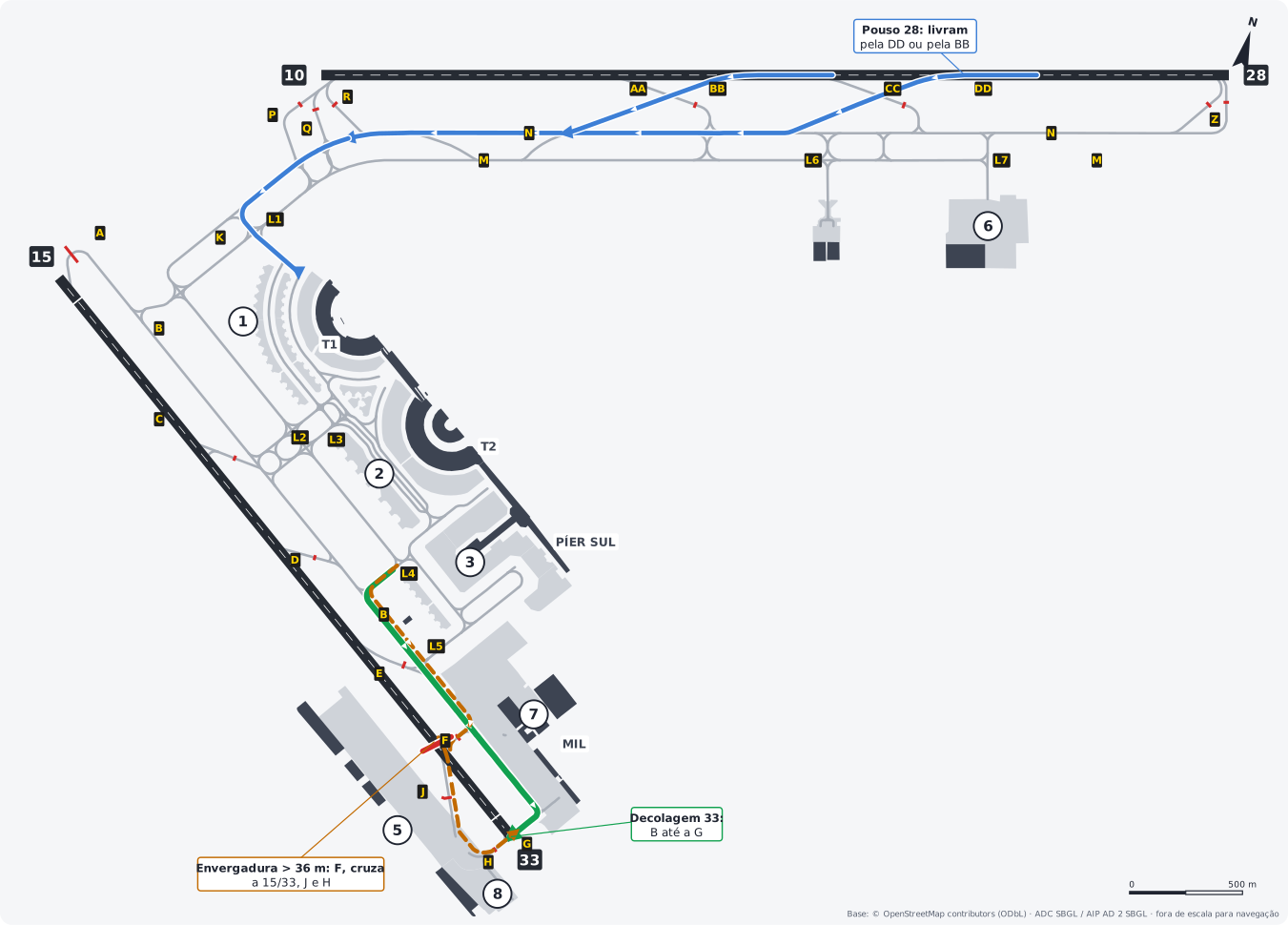
- Departures (33): B southeastbound to G, at the runway 33 end.
- Wingspan above 36 m (33): B to F, cross 15/33 with Tower clearance, J, across apron 5 and enter via H. B between F and G is limited to 36 m.
- Landings (28): vacate via DD or BB and continue westbound on N to L1.
Example: TAM3456, taxi to holding point runway 33 via L4, B, G.
Runway exits
Pilots must adjust their landing for minimum runway occupancy (MROT), especially at busy times5.
| Runway | Exits |
|---|---|
| 15 | D (~1390 m) or E (~1890 m) |
| 33 | C (~1960 m) |
| 10 | AA (~1090 m) or CC (~2060 m) |
| 28 | DD (~1170 m) or BB (~2080 m) |
Approximate distance from the threshold to the exit, measured on the diagram.
Taxi restrictions
| Restriction | Where |
|---|---|
| Maximum wingspan 36 m | Apron 1 and TWY Y1, Y2, Y3 and Y46 |
| Maximum wingspan 36 m | TWY B between F and G6 |
| Stop bars | K between L2 and L3; M between K and L1, between L1 and P and between P and Q; N between L1 and P and between Q and S; T between N and M7 |
Hotspots
- HS1: pilots crossing 15/33 via F and J have entered the runway without clearance. Cross only with explicit Tower clearance.
- HS2 and HS3: on AA and CC, watch out for inadvertently re-entering the active 10/28.
Takeoff points
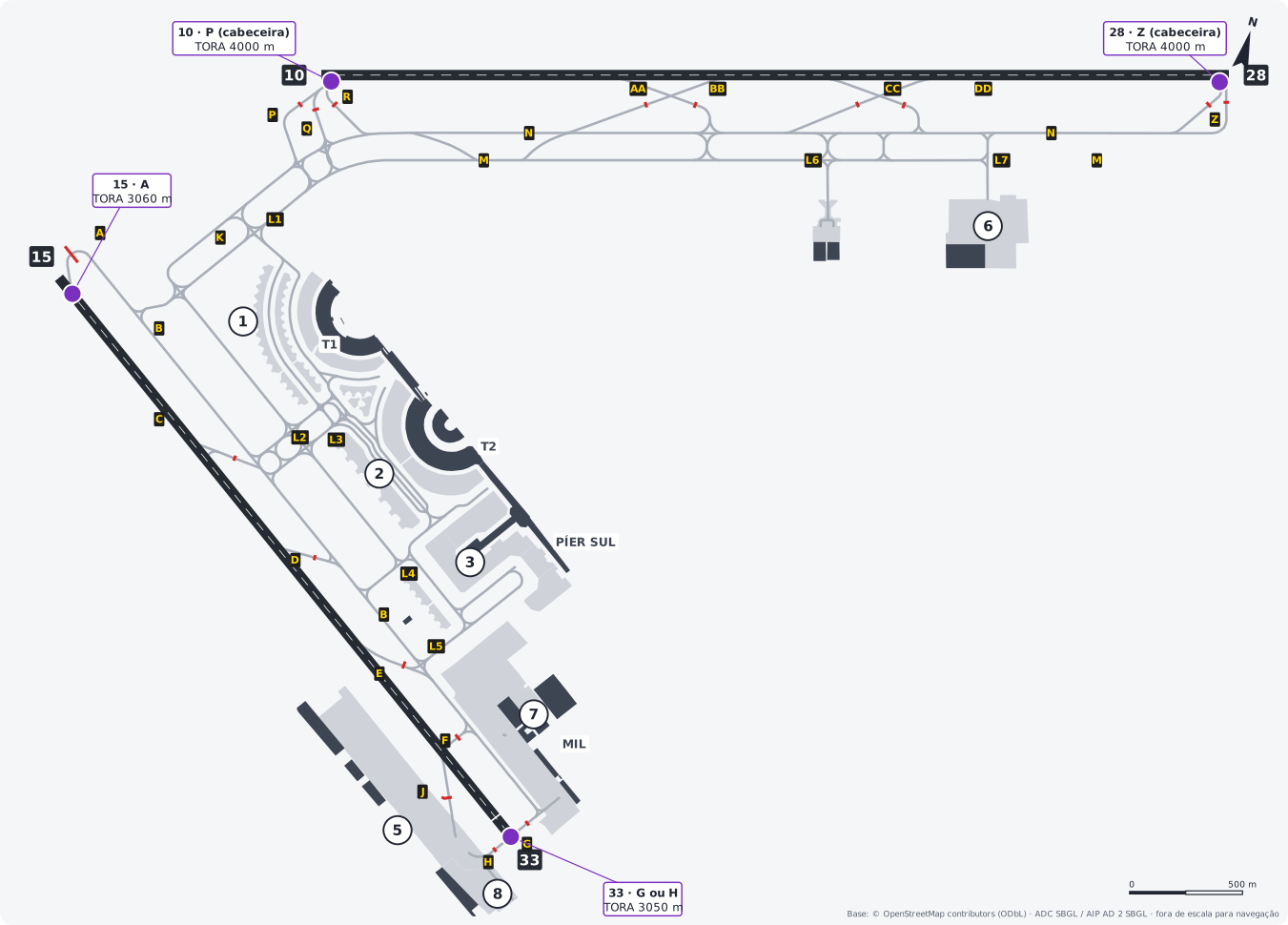
| Runway | Point | TORA |
|---|---|---|
| 10 | P (threshold) | 4000 m |
| 28 | Z (threshold) | 4000 m |
| 15 | A (start of the runway) | 3060 m |
| 33 | G or H (start of the runway) | 3050 m |
- Pilots reach the holding point ready for departure; if not, they tell ATC in advance2.
- Start the takeoff roll within 10 seconds of the takeoff clearance2.
- RBAC 121 aircraft may be cleared for simultaneous departures from SBRJ runway 02 and SBGL runway 158.
Converging operations
Tower may activate simultaneous operations on runways 28 and 33, always segregated: landings on 28 and takeoffs from 332.
Conditions (all)2:
- Visibility at or above the procedure minimum and ceiling at least 100 ft above the DH.
- The operation is announced on the ATIS (or by radio, without ATIS) when traffic enters the TMA.
- A specific approach chart in use, with "Converging" in its name (e.g. IAC ILS U (Converging) RWY 28). These charts have the missed approach point moved back from the threshold.
Pilots must2:
- Tell APP on first contact if they cannot fly the "Converging" approach.
- On a go-around after the MAPT, turn before the limiting radial on the chart. If unable, tell APP or Tower.
Cut-off point
The point on the 28 final that the approaching aircraft must not yet have passed for Tower to clear a takeoff from 33. Beyond it, nobody takes off from 33 until the aircraft has landed or gone around.
| Condition | Cut-off point |
|---|---|
| IMC | 3 NM from the runway 28 threshold |
| VMC (ceiling ≥ 1500 ft and visibility ≥ 5000 m) | 1.4 NM from the runway 28 threshold |
Cut-off point and phraseology: TWR-GL operational model, referenced in the AIP2.
On a go-around after the MAPT on 28, separation from the aircraft taking off from 33 may be reduced. In VMC, visual separation may work; give essential traffic information as early as possible.
PTATC, turn right for the missed approach procedure, essential local traffic, B737 starting takeoff runway 33.
PTATC, turn right for the missed approach procedure, essential local traffic, B737 taking off runway 33, passing midfield.
PTATC, turn right for the missed approach procedure, essential local traffic, B737 taking off runway 33, crossing threshold 15.
Aprons and airlines
A reference for simulation. Stands follow the PDC charts and the AIP; airlines follow the airport's airline list on Wikipedia. The split between stands is a simplification, not the airport's official allocation. VAs use the stands of the real airline they represent.





















Any airline, subject to availability and wingspan.


Aircraft under maintenance.
- Aprons 1, 2 and 3 take domestic and international commercial aviation, general aviation, air taxi and government aircraft. Apron 5 takes freighters, general aviation, extended stays and military transport6.
- Aircraft with a wingspan above 36 m do not use apron 16.
Logos from GRU Airport and Travelpayouts (Cargolux and Atlas Air). Trademarks belong to their respective airlines.
Other procedures
Approaches and landings
- Vacate the runway as quickly as possible (MROT)5.
- Pilots do not report gear down, except in an emergency.
Aerodrome regulations
- Follow the VAC to join and leave the traffic pattern10.
Diagrams drawn by VATSIM Brasil on OpenStreetMap geometry (ODbL), checked against the SBGL ADC and PDC charts. Not for real-world navigation. Normative source: AIP Brasil, AD 2 SBGL, AMDT 2610A1.
-
AIP Brasil, AD 2 SBGL 2.20, item 3. Declared distances: AD 2.13. ↩↩↩
-
AIP Brasil, AD 2 SBGL 2.8 and ADC chart. ↩↩↩↩
-
AIP Brasil, AD 2 SBGL 2.9. Hotspots: ADC chart. ↩